MANHATTAN — The act of covering the Sunflower Showdown in recent years has largely been an exercise in trying to guess which plays will live in infamy.
Kansas has now been close enough in three of its last four matchups with Kansas State to actually give some of its individual plays real import, which is no small feat considering where the program was a few years earlier. But those games have all ultimately been defined by a few moments at which the Jayhawks fell short.
Through almost a full half of football on Saturday at Bill Snyder Family Stadium, nothing particularly ignominious had occurred, which probably had some KU fans feeling hopeful and others dreading the inevitable.
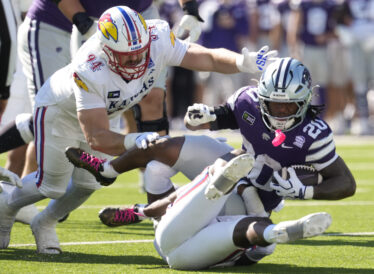
And sure enough, with KU leading 17-13 in the waning moments of the first half, punter Matt Gill bobbled a snap in his end zone and got knocked down immediately by K-State cornerback Nick McClellan, allowing the ball to bounce out of bounds for a safety — which in turn set up the field goal that gave the Wildcats their first lead of the day just before halftime at 18-17.
That was a classic KU Sunflower Showdown special-teams miscue, not unlike in last year’s game when Finn Lappin couldn’t handle a low snap from Emory Duggar and it went back for a touchdown.
Then in the fourth quarter on Saturday for good measure came a crushing turnover in the vein of Jalon Daniels’ late fumble in 2024: an end-zone interception thrown by Isaiah Marshall, really his lone mistake of the day, as the Jayhawks were driving to retake the lead in the fourth quarter.
As Marshall explained postgame, he saw his receiver Nahzae Cox beat Zashon Rich on a post route and did not at all see the safety, Logan Bartley.
“I think he was locked on the receiver … First-year starters have a tendency to do that sometimes and get locked in,” head coach Lance Leipold said. “It’s obviously a throw and a red-zone interception that you can’t have.”
That play — which decreased KU’s win probability from 58.9% to 35.7%, according to ESPN Analytics — and Gill’s safety will surely embed themselves in the memories of KU fans alongside Rich Miller’s dropped interception and Trevor Wilson’s muffed punt in 2023 and Quentin Skinner’s dropped touchdown and Jameel Croft Jr.’s special-teams gaffe in 2024.
“Frustration slash disappointment, those kind of go hand in hand in this one,” Leipold said on Saturday. “… I put this one in that category (of) some of the ones that I think that opportunity was there. There have been years that we haven’t matched up very well against them. So today I thought we did.”
As long as the Governor’s Cup exists there will always be more chances for the Jayhawks to end their brutal 18-year losing streak against the Wildcats. But if not when KU matches up well against K-State, then when?
It might be easy to circle 2027 in light of the prospect of KU battling KSU again, but this time with a veteran quarterback and a fully completed David Booth Kansas Memorial Stadium — but why should fans, for whom this game really holds profound meaning as Leipold has acknowledged, expect different results? It’s now four years in a row that the two rivals have entered the Sunflower Showdown on relatively even footing in terms of overall talent and all four, two in Lawrence and two in Manhattan, have gone the way of the Wildcats.
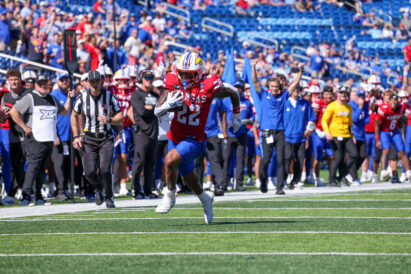
— KU has gotten a lot right on special teams the last two seasons in particular, after struggling at times there earlier in Leipold’s tenure. The early kick-return touchdown for Bryson Hayes, a nice moment for a Maize High kid, was evidence of that fact.
Gill’s performance was a reminder that the Jayhawks are far from perfect. The Australian punter has had an uneven start to the year in his first-ever gridiron football action, with his 17-yard punt against Arizona State unfortunately his most memorable moment prior to Saturday.
On Saturday, his rough showing went beyond just one poor kick. Safety notwithstanding, he made it very difficult for KU to change field position at any point by punting for 31, 32, 29 and 40 yards. As compared to a middle-tier Big 12 team that averages 45 yards per punt, that’s essentially giving up a cumulative 48 yards of field position. And to be clear, he wasn’t just punting from his own end zone. These kicks originated from KU’s 33-, 27-, 28- and 39-yard lines.
“For the most part, Matt didn’t have a good day punting,” Leipold said. “I can’t tell you why. He was our player of the week last week, and he averaged 40-something yards a kick, and then we average 33 yards today. There’s nothing I know injury-wise or anything like that … Can’t say for sure if anything environmentally here got to him, but it wasn’t his best day and we never got a chance to flip the field like we had hoped.”
Finn Lappin, whose 45.3-yard single-season per-punt average in 2025 was third in KU history, might not have received enough acclaim during his lone season as a Jayhawk.
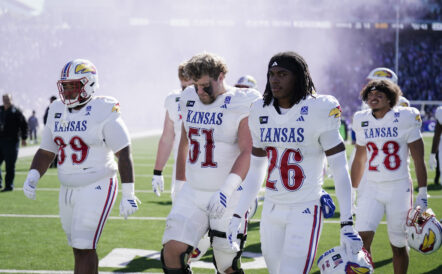
— One understated storyline entering Saturday’s Sunflower Showdown featured Goodland’s Cure brothers, tight ends Leyton (KU) and Linkon (K-State), on opposite sides of the rivalry. Each player carried the Kansas flag onto the field for his respective team.
Linkon, a formerly highly touted recruit whom KU pursued once upon a time, came to the forefront on Saturday with the Wildcats’ Will Anciaux out for the season and Garrett Oakley sick. It was interesting to see how K-State attempted to make use of his receiving acumen, lining him up at tight end but motioning him out wide ahead of the snap for a running start on a number of occasions. In the end he didn’t contribute all that much for K-State, catching both of his targets for 16 yards and drawing a pass-interference penalty on Roman Pearson but also fumbling, which led to a KU field goal (more on that later).
Leyton, a sixth-year senior who began his career at Fort Hays State, has quietly molded himself into an auxiliary receiving threat for Marshall. Considering that Jailen Butler has just two catches for 29 yards this year, it seems noteworthy that Cure followed his impressive 30-yard reception against Utah with a pair of 22-yard catches against the Wildcats. Associate head coach Andy Kotelnicki excelled to such an extent at scheming his tight ends wide open during his first tenure at KU and it seems like Cure is starting to reap the benefits every now and then.
It had little to do with the overall outcome, but the elder brother played a larger role for his team on this day.
— The marquee storyline of the day focused on Dylan Edwards, the former K-State running back who made the unprecedented decision to cross rivalry lines and transfer to KU in the offseason. Unsurprisingly, the KSU fans booed him every time he touched the ball on Saturday, although perhaps more accurately they booed him every time his name was announced on the PA (it’s not quite like basketball where fans can more easily tell in real time who has the ball at any moment, I suppose).
Edwards had an OK game, with 16 carries for 57 yards and two catches for 29 yards. The Jayhawks force-fed him the ball early with some initial success, and he touched the ball on six of their first seven plays. He scored a touchdown in front of his former fans in the third quarter and had a slick 18-yard run in the fourth. Leipold said he “handled the week extremely well and very maturely.”
But ultimately the KU running backs still really aren’t much of a factor, which is a bit problematic for a team relying so heavily on a young quarterback.
— That quarterback, Marshall, has started to find his own niche in the run game. He carried the ball 14 times for 117 yards against K-State, demonstrating impressive straight-line speed like he had when he was serving as a gadget player behind Jalon Daniels, and his instincts regarding when to leave the pocket or take off running seem to be getting better and better.
His final stat line could actually have been a lot better and significantly more impactful.
First of all, on the first play after Linkon Cure’s fumble, Marshall took off for 27 yards and a touchdown. A hold by Cam Pickett — five yards from the goal line — took those points off the board, and KU eventually settled for a field goal. That meant a 10-point lead instead of 14; the Jayhawks have never led by more than 11 points in the Sunflower Showdown during their 18-year losing streak.
Later on, even after Marshall’s ill-timed interception, a potential rally was still well within the Jayhawks’ grasp as they trailed 32-24. Facing a third-and-11, he took off for a 46-yard score — one that quickly fell by the wayside because guard Amir Herring essentially removed Kamari Burns’ helmet during what was otherwise a normal block.
That offensive facemask penalty put KU in third-and-26. Marshall threw incomplete to Leyton Cure — he later said he should have targeted Pickett instead for a gain of about 20 yards — and the Jayhawks had to punt.
By the time they got the ball back K-State had its first two-possession lead with 1:56 remaining.
It was undoubtedly a vexing series of events for a player who still has just one career rushing touchdown (compared to 415 yards), and for his team.
“Just keep the guys up,” Marshall said of his approach following each penalty. “Nobody in the huddle was down or anything like that. It got called back, but we see what we can do, so let’s keep going and let’s score again. That was the mentality, it was ‘Let’s do it again.'”
— Before the season started, looking at the first half of KU’s schedule, it was difficult to pick out a likely win against a power-conference team, despite the Jayhawks’ apparent talent. The Arizona State game in London seemed like it might be their best chance to steal one and end up at 3-3, theoretically on pace for bowl eligibility.
Well, here we are halfway through the schedule, and despite the Jayhawks’ apparent talent, they haven’t beaten a power-conference team, and ASU was their best chance to do so, but they squandered it (despite an impeccable defensive performance).
So now they’re 2-4.
“We can play with people,” Leipold said. “That confidence hasn’t waned whatsoever. It’s just that sometimes in these situations our margin of error’s very small, and you got to play clean, especially when you’re on the road playing against a team that’s playing with confidence in the game and doing things, you got to find a way to do that.”
The second half of the schedule has always looked more manageable. It includes all three of KU’s conference home games, and its upcoming road foes aren’t as good as Utah. But the issue at hand was always going to be whether this team was going to be in an emotional and developmental position to set its season on track — without the benefit of a bye week for a breather at any point — when the somewhat easier games arrived.
“It’s definitely a little challenging just to keep the spirits high and all types of stuff like that,” wide receiver Nik McMillan said. “But that’s just part of what we signed up for, though.”
Leipold authored a late-season turnaround in 2024, even after KU lost in Manhattan that year to fall to 2-6. He actually has a longer runway this time around. But he’ll be trying to get the Jayhawks on the right track, beginning on Saturday against Baylor, with a young team that still has yet to prove itself against high-level competition.
“I ask that our fan base keeps looking at this team competing and where we’ve been, and we have a chance to win,” Leipold said. “I still believe we can win every game on our schedule. Now, as I told our team with the margin of error, every game is winnable. That’s the way this Big 12 Conference has been set up for the most part, there’s a few, maybe, that end up pulling away, but again, there’s winnable games. I think our guys have played and responded back in these situations, and it’s a challenge.”
If the Jayhawks want to beat the Bears, they’ll have to defy historical precedent. Baylor has beaten KU 14 straight times.