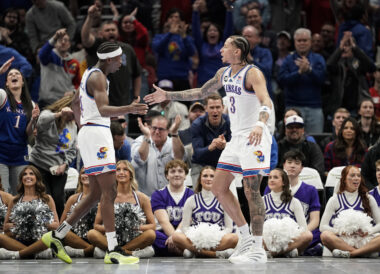
As Kansas coach Bill Self put it last week before cementing Melvin Council Jr.’s return, the addition of one more player beyond Tre White — occupying the Jayhawks’ 15th roster spot — could yield “a crowded house in many ways.”
But, he added, “Whatever makes the team better, I think they’ll be OK with that.”
It’s hard to argue that bringing back the Big 12 newcomer of the year, the talisman and leader of last season’s team, could be anything other than positive.
But it’s also reasonable to wonder how the crowding of said house might impact some of its existing occupants, and especially the young guards whose ongoing development will have a lot to do with the Jayhawks reaching their ceiling in time for next March.
What follows is an evaluation of Council’s return and its potential pros and cons — providing an illustration of how in many cases the same piece of information about a given player can be easily recontextualized to suit either side of an argument.
ON ONE HAND: Bringing in an established lead guard who seems like a lock to start and play substantial minutes will take away valuable experience from Taylen Kinney. Kinney is already clearly very skilled with the ball in his hands and has been for a long time, but he will need time and space to develop his ability to command the Jayhawks’ offense — it’s been some years since head coach Bill Self consistently started a freshman point guard — and playing Council on the ball will infringe on that.
ON THE OTHER HAND: It also eases the pressure on Kinney to play up to his five-star billing from the moment he arrives on campus and could allow him to take on a more significant role only once he has adjusted to the pace of the collegiate game. That won’t just ease his burden when running the offense, but also on the other end of the court. Council will readily accept the responsibility of taking on the other team’s best guard — something he’s better suited for anyway given his length at 6-foot-4 — and make things easier for Kinney and Leroy Blyden Jr. alike in the process.
ON ONE HAND: Council, like Tre White, is coming in late to a team that has already spent the better part of four months establishing rhythms and patterns and could potentially disrupt all those things. Throw in the fact that either one could be ruled ineligible at midseason and it’s a recipe for underdeveloped team chemistry.
ON THE OTHER HAND: All Council and White have done throughout their itinerant careers is integrate themselves into brand-new teams, and their production has remained consistent regardless. In Council’s case in particular, the teams that he’s been on have all attained at least some level of success.
As for the looming specter of ineligibility, that’s something many of KU’s competitors will have to deal with as well — any ill effects will be dispersed throughout the Big 12. (You think it wouldn’t hurt Iowa State to suddenly regain and then just as suddenly lose Tamin Lipsey?) And should either or both of Council and White become unable to play, well, the rest of the Jayhawks will be able to fall back on that four months’ worth of past experience when they thought their roster might have been set the first time around. See how that works?
ON ONE HAND: Council takes quite a lot of shots, 13.5 a game in his three years of Division I basketball, and he doesn’t make them at a particularly high rate: 40.5% from the field, 29.1% beyond the arc. These numbers really haven’t changed all that much in his basketball career, even dating back to junior college, and it’s hard to imagine them taking a dramatic turn in his sixth year. Throw in the fact that he often played better without Darryn Peterson than alongside him last season, particularly in the late stages of the year, and there’s reason for concern about his high usage rate taking away from what should be a talented supporting cast, perhaps a more talented one than last season’s.
ON THE OTHER HAND: Last season’s supporting cast was in fact the reason why Council had to be so ball-dominant in the first place last season. When Peterson was unavailable due to his recurring injury and cramping issues, there were times when Council was the only viable shot creator on the floor (though White did prove somewhat more adept in that realm than expected entering the year). He wasn’t throwing up shots for the sake of it; in many cases last season his drives to the rim or off-balance floaters were the only reliable source of points on otherwise doomed possessions. Council was very clear from the start of his KU tenure that he was determined to help Peterson be the best player he could be (the Robin to his Batman). He will be under no illusions as to his role in relation to that of Tyran Stokes.
ON ONE HAND: By occupying KU’s final roster spot — and Self has said there is no loophole that would allow the Jayhawks to add anyone else — Council prevents his team from adding an accomplished player at a position of greater need. Someone like rumored target Trey Kaufman-Renn, a former 20-point-per-game scorer at Purdue and the cousin of KU women’s basketball forward Brooklynn Renn, or even former Rutgers center Emmanuel Ogbole, for whom KU filed eligibility waivers, would have helped address the Jayhawks’ lack of frontcourt depth.
ON THE OTHER HAND: First of all, it’s not like KU was teeming with ball-handling options. The Jayhawks were facing the very real possibility of having their only two real point guards, Blyden and Kinney, start together in the backcourt and barely leave the floor at any point. Tyran Stokes can initiate offense too, but he’s a freshman himself and may end up doing some of his best work when off the ball and causing matchup problems in the paint.
In addition, the opportunity to return a player of Council’s productivity is a rare one in the Self era. In the last decade, the three previous guards to return after averaging at least 12.7 points per game were Frank Mason in the 2016-17 season, Devonte’ Graham in the 2017-18 season and Ochai Agbaji in the 2021-22 season. All three won Big 12 player of the year honors and were consensus first-team All-Americans; Mason, of course, was the national player of the year and Agbaji was the Final Four MOP.
Finally, White’s arrival should tilt the balance in favor of small ball anyway and lessen the number of minutes Paul Mbiya and Christian Reeves have to play regardless, so the center concerns no longer matter quite as much as they once did.