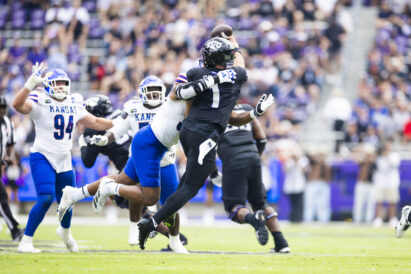
For as much as D.K. McDonald’s defense has improved this season, it just can’t seem to find the stops it needs in the most important moments.
Whatever momentum it may have accumulated, however much it may have shut down an opposing team’s key players up to a particular point, that just doesn’t seem to translate to the final, crucial drive.
“No matter how many times we’ve stopped them during the game, we need to stop them one more time to win that game,” McDonald said. “We didn’t do that.”
To be clear, that was a quote McDonald gave on Tuesday. He was talking about the road loss to TCU.
Four days later, his unit forced three consecutive stops beginning late in the three quarter — two of them three-and-outs and one just one play longer — to buy time for KU’s offense to rally from a double-digit deficit and take the lead with a minute to go.
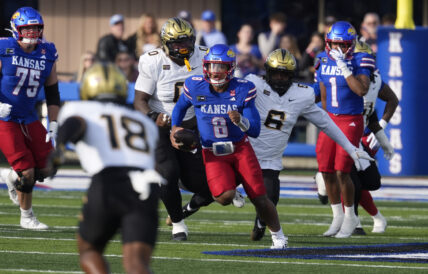
Then it was on the Jayhawks’ ostensibly more consistent unit to hold, and it couldn’t. UCF quarterback Alonza Barnett III completed passes of 20, 20 and 19 yards before finding tight end Caden Piening for the game-winning touchdown with one second remaining. And McDonald, his fellow coaches and their players will find themselves looking for answers once again after the Jayhawks’ latest close loss, a 33-32 heartbreaker at David Booth Kansas Memorial Stadium.
“I wish I had the magical answer, because we’d correct it right away, obviously,” head coach Lance Leipold said. “There’s some things, I don’t know if we get tentative in spots or whatever. There’s been some plays made by the opposing team that have been pretty impressive, I think contested catches and some others, but again, just not enough at the time, and we’ll continue to look at what we got to do better.”
As defensive end Leroy Harris III put it, the defense is making some great plays along the way. He and teammate David Santiago in particular: Harris had six tackles with three sacks and a forced fumble and Santiago, who spent part of the week on the availability report, tallied six tackles, including 2.5 for loss and a fumble recovery. But the unit isn’t playing a full game.
“When it’s nut-cutting time, winning time, they made more plays than us,” Harris said, “and that’s how they ended up winning the game that last drive.”
There was some doubt as to whether UCF had in fact won it. Two plays after officials overturned a potential game-winner for Waden Charles, they upheld Piening’s, although the ball moved in his right hand as safety Taylor Davis brought him to the ground.
“You don’t want to get bailed out by the ref,” Harris said. “You got to make the play. You got to make the play at the end of the day. Don’t put them in that situation to even have that opportunity to make a call like that.”
Leipold said he initially thought it was a touchdown, then had second thoughts when he saw a zoomed-in replay. In any case, he added, it was “too close to tell,” and a call on the field getting upheld means there isn’t enough evidence to reverse it.
As Harris put it, “We shouldn’t even have been in that situation.” As has often been in the case in recent years, the Jayhawks gave their opponent too many chances.
And indeed, since one second went back on the clock after the play, UCF would have had another shot from the 6-yard line even if Piening’s catch had been overturned.
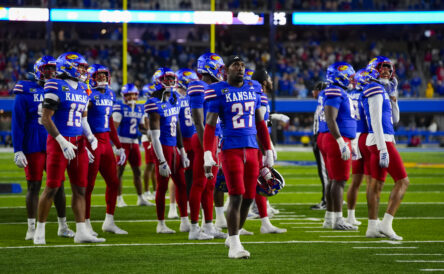
Here’s more of what we learned from KU’s latest loss, which dropped the Jayhawks to a grim 3-6 record on the year.
— When Dylan Edwards punched in a 2-yard touchdown to put KU ahead with just over a minute left, I’m sure plenty of viewers wondered — particularly given the Jayhawks’ history — if they had scored too soon.
They really couldn’t have scored any later under the circumstances.
After Isaiah Marshall’s 42-yard toss to Nahzae Cox, which looked like it was going to be the deciding play of the game, KU faced first-and-goal from the 5-yard line with 1:13 remaining and UCF holding all three timeouts.
Because of those timeouts, it would have been essentially useless for KU to try to run the ball and settle for a field goal. If they ran straight ahead three times and burned all three timeouts, then kicked a chip-shot field goal, they’d be giving the ball back to the Knights with a minute left and just a one-point lead.
In fact, it was good that they got UCF to burn even one timeout, even as the Knights seemed indifferent to whether Edwards scored on his first-down carry.
“We had contemplated not scoring one (more) play and then possibly scoring, but it’s still only going to be a matter of, like, four seconds,” Leipold added.
So no, that was not a clock-management blunder by the Jayhawks. It was a pretty optimal approach given the situation at hand.
On the other hand…
With 1:43 remaining in the first half and KU trailing 12-7, on first-and-10 from KU’s 26, Santiago tackled UCF’s Taevion Swint for a 4-yard loss. The clock ran 34 seconds before the Knights ran another play: a 1-yard loss by Barnett. The clock ran 32 more seconds before Harris sacked Barnett — and then ran 20 more, all the way to one second left, before UCF’s Will Stone missed a long field goal.
Wouldn’t it have been nice for the Jayhawks if he missed that long field goal 86 seconds earlier?
Leipold said postgame that he did not consider burning KU’s three timeouts in this sequence.
“No, not at that time,” he said. “Our rhythm wasn’t there. We hadn’t been moving the ball that well. So at that particular time, can’t say it did.”
He’s right in one respect: The Jayhawks were getting absolutely nothing done on offense. At that point they had 61 total yards, about half of which came on quarterback runs by Marshall.
But on multiple occasions this year, the opportunity to play with tempo has revived KU’s passing attack; consider the late stages of the Arizona State loss or the pre-halftime stretch at Utah. That Leipold didn’t even try to give his team a chance to possess the ball here — especially with UCF set to get it back after halftime — was very strange, and the Jayhawks ultimately didn’t find their rhythm until halfway through the third quarter. He wouldn’t even have needed to call all three timeouts if he was worried about UCF fighting its way back from second-and-14. Just two, after the following two plays, or one, after third down, would have sufficed to give KU at least a chance.
— It was strange that Davis even found himself in for the decisive final play, one where KU attempted to “put a fence up” at the goal line against the Knights, as Leipold put it. The usual starter at boundary safety, who actually made a key goal-line stand against TCU, had barely played on Saturday after showing up on the availability report. The same was true of teammate Jaden Harris.
In their absence, Christian Pritchett received his most extensive playing time as a Jayhawk — but then he too got hurt, requiring his teammates who were not 100% to fill in at the game’s most crucial moments.
“It’s what you got available,” Leipold said. “It’s kind of tough. Taylor missed two days with illness. That’s why he didn’t play much today and kind of pressed in there. Jaden’s been kind of fighting through things, and Jaden Harris tries every day to get himself in a position to get on the field and moving the best he can, but it’s where we’re at health-wise right now with some of those spots, and had to put them in.
“Again, you hope between mental reps, film study and banked reps along the way that there’s some things that guys are going to be able to come in and do some things.”
A quick review of the tape shows that Davis didn’t make any glaring missteps on that final drive, but it was a brutal set of circumstances for him to have to return to action.
— In general, KU sustained some tough injuries in this game. Running back Khijohnn Cummings-Coleman, defensive tackle Kevin Oatis, wide receiver Cam Pickett and left guard Connor Stroh were among the Jayhawks who got banged up at various points. Linebacker Bam Crouch, a game-time decision, didn’t play at weak-side linebacker and was replaced by Quincy Davis. We’ll see what Wednesday’s availability report brings ahead of KU’s trip to West Virginia.
— I still don’t know what KU is doing on kickoffs, but it isn’t working, as opponents continue to post long returns with a high level of regularity.
Against Baylor on Oct. 24, the Jayhawks briefly replaced kickoff specialist Dane Efird with typical placekicker Martin Connington and switched to pooch kicks instead of attempting to kick deep. Efird returned to kickoff duties against TCU on Oct. 31, albeit without recording a touchback.
On Saturday, KU made the odd choice to send out freshman walk-on punter Ben Shipley for his first career collegiate action on a kickoff, which he promptly sent 55 yards out of bounds. After halftime, Efird was back, only to muster just 58 yards and have Swint return a kick to midfield. Then came a 38-yard pooch kick in the third quarter.
Efird seemed to find a bit more success in the fourth with two kicks that reached the goal line and one that made it to the 1-yard line. Special teamers Micah Johnson and Isreal Moses V deserve credit for strong tackles on Swint that made UCF’s job somewhat harder on its late drives.
While there may be a certain element of surprise to varying kicks, at some point one of KU’s kickers, probably Efird, has to find a way to get the ball through the end zone. KU opponents are averaging 28.2 yards per kick return. If that were a single team’s production it would rank around the top 10 nationally.
If Shipley’s going to be involved at all, it should be in the punting game, where Matt Gill again averaged less than 40 yards per kick on five attempts on Saturday.
One more special teams note: It didn’t work, but I appreciated on one late punt return when KU used a bit of misdirection to make it look like Tate Nagy was going to return a punt that was actually headed for Keaton Kubecka on the opposite side of the field. The punt went for a touchback, but it’s a smart thing to try when you’re hoping to give your offense a spark.
— On a similar note, KU still hasn’t figured out a way to get its inside run game going, but I appreciated seeing reserve tackle DeAndre Harper wear No. 36 and line up as a fullback on Saturday. It reminded me of what Kansas State has done at times with Oliver Miller wearing No. 45 as an extra tight end this year.
I’m not sure the 6-foot-6, 320-pound redshirt sophomore will be catching any passes any time soon, but at this point, the Jayhawks have to try whatever they can to get Edwards and the rest to the second level.
— It’s hard to square just how much Leipold and his staff have talked about working on situational football over the last two years with how little of a difference it seems to have made.
The Jayhawks are now 3-10 in one-score games since the start of the 2024 season, and unlike for virtually every other football team in existence, holding a fourth-quarter lead seems to have little impact on whether they go on to win a game.
Trying to reverse these trends feels increasingly hopeless — apparently including for those who have been in the trenches. On Saturday night, KU’s all-time leading rusher Devin Neal wrote in a series of Instagram stories, “Can’t even make this up bro…”, “Literally the same horrors for 3 years…smh” and, for good measure, “Y’all I’m fine I’m talking about my Jayhawks” — in case there was any doubt.
That blocked field goal against Baylor provided some hope that KU would get back on track, but the horrors of which Neal writes show no signs of ceasing now that two inexplicable losses have followed it in quick succession.
“We got to continue to pound away,” Leipold said. “That’s all there is. We’re going to keep coaching them, keep coaching them hard, keep coaching them better, try to find a way to get us to get to that 60-minute point that we can get some wins.”
The wins have been sorely lacking. KU is now 3-6 and at risk of its worst season since Leipold’s first year. The 2023 Guaranteed Rate Bowl feels like an age ago.
“We’re not out of (bowl contention) yet, but I would say this, that we’re going to continue to fight and go,” Leipold said. “I’m disappointed that we haven’t put ourselves in that position and that’s my responsibility as a head football coach, to get us there. For that, I apologize to our fans and we’re going to keep working. But it’s not over until it’s over that way, I guess, so I’m not conceding anything right now. I’m not built that way.”