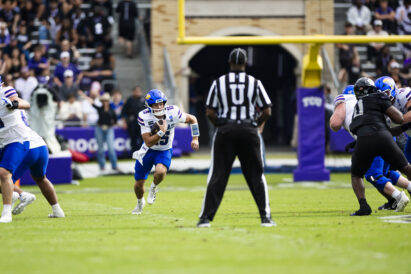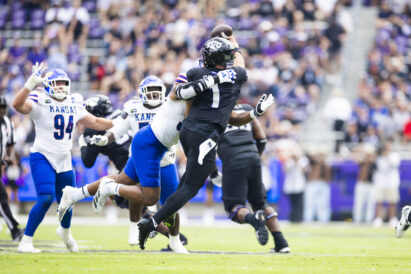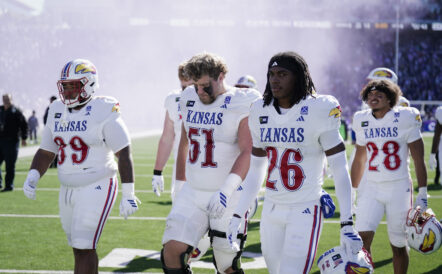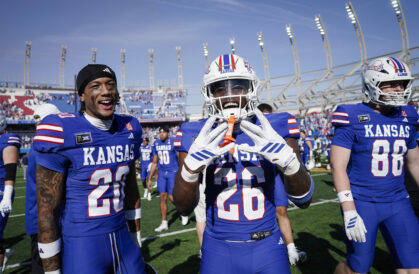
FORT WORTH, Texas — The final word in Saturday’s postgame media availability, after one of the more dispiriting losses of Lance Leipold’s tenure as head coach, went to junior cornerback Jalen Todd.
Todd was asked about KU’s recurring issue of losing games in which it had led at halftime.
“It’s a frustrating thing,” he said. “Like, same thing happened last year and the year before. It’s just frustrating.”
That kind of sums it up, doesn’t it?
The method in which Saturday’s 22-16 loss to TCU in Fort Worth unfolded for the Jayhawks was a little bit different than in Todd’s first two seasons — KU completely stymied the Horned Frogs, until a defensive touchdown brought them back from the dead and they essentially harnessed the momentum from that game-changing play to erase the rest of their deficit — but the result was the same: another head-scratching loss.
File it away with other demoralizing one-score defeats in which foes have gotten the best of KU late, games like Illinois, UNLV, West Virginia, Arizona State and Kansas State (2024); Cincinnati and Arizona (2025); and this year’s ASU game. That’s not to mention battles that were close throughout but drifted away from the Jayhawks, like TCU (2024), Missouri and Utah (2025) and this year’s Kansas State game.
It’d be one thing if KU were winning in dramatic fashion just as often, but that total vastly outweighs the few times in the last three years when KU has come out on the right side of such results with late-game heroics: BYU (2024), UCF (2025) and of course last week against Baylor.
In recent years Leipold has ratcheted up the Jayhawks’ emphasis on situational football with an eye toward finishing games like these better. But it still isn’t being borne out on the field with anything resembling consistency.
That’s how you get a team with a bigger lead than it’s had over a power-conference foe in a year not just blowing that lead but failing to get back on track when offered multiple opportunities to do so down the stretch.
And that’s how you get a loss to a TCU squad whose fans, at least those that dispersed themselves throughout a generously listed two-thirds-full Amon G. Carter Stadium, were chanting to fire their coach on multiple occasions in the first half. That’s how you get a 3-5 record and, as Leipold put it postgame, an “extremely dejected” locker room.
Here’s more of what stood out from Saturday’s loss.
— You just can’t waste an opportunity as good as the one KU got to start the game. For a team that doesn’t create a lot of turnovers, a muffed punt to start a drive at the 32-yard line is a godsend. Yes, TCU’s defense may be, as Leipold said postgame, “the best defense in the Big 12 right now, and a top-10 defense.” That’s precisely why chances like that one are so important, because how often was KU going to be able to drive the ball all the way down the field against the Frogs? As it turned out, its only touchdown drive of the day ended up spanning three plays and just over a minute.
In any case, to go backwards on consecutive run plays then lob a doomed fade route to slot receiver Cam Pickett was inexcusable. Even if Martin Connington hadn’t missed the chip-shot field goal that followed, it would have been a waste.
When the Jayhawks entered halftime up 13-0, it looked like that early stumble might have been an aberration, a footnote on an otherwise joyous day for KU. Instead it just presaged what was to come for the Jayhawks in the second half: four more drives that reached TCU territory without producing points.
— Leipold is going to catch a lot of heat for going for it on fourth down twice with a 13-0 lead in the third quarter. He really shouldn’t.
Let’s set aside the actual plays KU called and focus on the strategic decision-making. With fourth-and-goal on the 2-yard line halfway through the quarter, it obviously doesn’t make sense to kick a field goal to try to increase a two-touchdown lead to a two-touchdown lead.
“Inside there we were going to be aggressive,” Leipold said. “Everything that we say that we look at, analytics, everything like that, to be inside there, the numbers said definitely was a go situation. We thought we could have something there — just like we got a stop right before half inside there, so did they, unfortunately. That’d have been a huge play for us, obviously, and momentum and the lead and all those things, and definitely was part of the swing in momentum.”
Indeed, if KU had in fact been able to go up 20-0 there, it might have been the knockout blow; but even though the Jayhawks failed, the play of their defense made it quite clear they would be able to get the ball back in short order with good field position. That’s exactly what happened, as TCU went three-and-out and KU started its next drive at the Frogs’ 44-yard line.
Once again ignoring the potentially dubious choice to run twice with backup running back Chase Belcher and once on a read option with backup quarterback Chase Jenkins, there’s nothing wrong in theory with going for it on fourth-and-5 from the 39-yard line. Has Matt Gill’s punting this season given anyone confidence that he would be able to pin TCU back deep? Is it worth risking a touchback that would net a mere 19 yards of field position?
“The number in that part of the field, I think it was eight to nine yards that you’re still going for it,” Leipold said.
What followed, of course, was the absolute worst-case scenario, a pick-6 for Max Carroll that dropped KU’s win probability by 18.7%, according to ESPN Analytics. It looked like the Jayhawks were trying to run some sort of mesh concept and TCU absolutely blanketed it. Cole Ballard was right to try to get the ball near his receivers instead of hopelessly throwing it away on a fourth down but would have been better off at least trying to get it past the first-down marker, if he could muster the strength while throwing off his back foot.
In any case, there was nothing wrong with going for it on that fourth down. Any other assessment is entirely outcome-based rather than process-based.
— It’s pretty remarkable that KU lost a game in which two of its receivers had career days. Nahzae Cox was impeccable as a deep-ball contested-catch threat in this game and came away with 145 yards, by far the highest total in his two seasons at the NCAA level.
Pickett regained his form from the Utah game earlier this year and had a career-high 10 catches for 113 yards and a score. It certainly didn’t look like either player was disrupted by having to play with a backup quarterback, nor facing off against a strong secondary.
Even Keaton Kubecka made his mark in his first game back from injury, not so much through the passing game as on the ground, where thanks in large part to a 40-yard run he was the Jayhawks’ leading rusher.
The most notable absence was that of Nik McMillan, who played 46 snaps, according to Pro Football Focus, but was targeted just once — on Ballard’s interception — and didn’t record a catch. Notwithstanding everything else above, that’s not a recipe for success for the Jayhawks.
— During the 2025 season, I criticized KU for playing Jalen Todd at nickel back, arguing that it didn’t make the right use of his talents as the Jayhawks’ best cover corner and, at a thin position, left inferior options on the outside to deal with some of the best wideouts in the Big 12. So I wasn’t immediately thrilled to see that KU’s solution to some of its health issues at nickel this year — most notably a recent injury to Elijah Cannon — was to slide Todd inside against TCU.
It turned out to be quite apparently the best possible choice for the Jayhawks.
“It’s been good, trying to knock the rust off from last year,” Todd said.
First of all, it made sense because of the Frogs’ talent in the slot, but even more importantly, the outside corners held up far better than I could have anticipated. The embattled Austin Alexander was targeted 10 times on Saturday, the second-highest single-game total of any Jayhawk this year (Cannon against Missouri was first), but allowed just four catches for 29 yards with some of the best open-field tackling of his career. Roman Pearson gave up one catch for seven yards and was responsible for maybe KU’s biggest hit of the season. When freshman Trey Brown did take the field, he blended in better than in previous weeks.
Jahlil Hurley managed to commit a penalty on one of his three snaps, but for the most part it was actually Todd who had the most trouble on the day, at least by PFF’s assessment, conceding four catches for 69 yards. He did recover a fumble on special teams.
In any case, this alignment looked far more credible than when it was deployed last year — like most elements of KU’s defense this season.
— In another timeline, the Jayhawks’ goal-line stand right before halftime might have been the deciding factor in a KU victory. By all rights, preventing the Frogs from scoring before halftime, with KU set to receive the second-half kickoff, should have been a decisive moment in the game. (And yet…)
I wanted to note one element that might have gone unnoticed. Taylor Davis put an impressive hit on Jacobe Hayes to knock him out of bounds short of the goal line, yes. But TCU might have had the look it wanted had the timing been a split second different.
Quarterback Jaden Craig called for the snap right as Hayes, in motion from right to left, was about to pass behind left tackle Ben Taylor-Whitfield. Taylor-Whitfield dropped back to protect Craig but in the process brushed against Hayes and impeded his momentum just a hair. That might have given Davis the time he needed to get over and make the play at the pylon.
— Ballard was very lucky not to have thrown a second pick-6. The pass-interference call on Kalen Carroll that took away Jamel Johnson’s defensive touchdown in the fourth quarter was very light, and Ballard’s pass was high enough that tight end Jailen Butler probably wouldn’t have been able to catch it even without the interference.
Considering that KU went ahead on a field goal by Connington soon afterward, that play would absolutely have come in for a great deal of scrutiny had the game gone the other way.
In general, I’m not giving KU a pass on offense for having had a backup quarterback in this game. The coaches spoke throughout the offseason about believing they had two quarterbacks they could win games with. Ballard should be held to a reasonably high standard, even as one can also acknowledge that he didn’t have a huge amount of time to prepare for this appearance and that he only returned from his own injury in the last couple weeks.
— TCU got away with a really poor clock-management blunder that almost cost the Frogs the game.
After Craig’s first-down run with 1:38 to go, the Frogs had complete control of the game, with KU out of timeouts. TCU trailed by just two points and could easily have run down the rest of the clock and set up for a game-winning field goal. Instead, Craig scored immediately, giving the Jayhawks a chance with the ball in their hands and over a minute left that they never should have had.
I understand that college football teams don’t always have a lot of confidence in their kickers, and in fact TCU’s Kyle Lemmermann had only attempted one field goal this season because he apparently missed time due to injury. So Craig could have just chosen to slide down at the 1-yard line. The probability of making a 19-yard field goal is surely higher than the probability of withstanding a late drive when you give your opponent over a minute to work with.
If the Jayhawks had made better use of their final series once they got across midfield, Craig might have been regretting his game-winning touchdown.
— Where does KU go from here?
“We’re hungry,” Ballard said. “We’ve been hungry. We got four games left and we still have a chance to make a bowl game. We’ve got a lot of winning left to do.”
But a postseason appearance certainly looks like a long shot. This was a golden chance for the Jayhawks to even their record with a manageable game coming up against UCF on Saturday. Instead, they will need to beat both the Knights at home and West Virginia on the road just to return to .500, and then hope for a dramatic upset over BYU or Oklahoma State.
KU still hasn’t really won a game against a team it wasn’t supposed to beat since late 2024. If they want a bowl bid, the Jayhawks will have to channel the spirit of that late season-run in the weeks ahead — except, of course, for the part where it still ended at 5-7.