MANHATTAN — Through its first four games of the 2026 season, the Kansas football team held its opponents to a total of 400 rushing yards.
The Jayhawks’ defensive front, combining elite defensive ends in Leroy Harris III and David Santiago with a steady rotation of defensive tackles and the solid linebacker play of Trey Lathan, Quincy Davis and more, forced its opponents to attack KU through the air, with varying levels of success.
KU’s form declined on Oct. 10 with what defensive coordinator D.K. McDonald called a “horrible” performance against Utah — one that included 287 yards on the ground — and the question on Saturday against Kansas State would be whether that was a mere exception or more representative of the sort of damage other Big 12 foes could do against the Jayhawks on the ground.
The Wildcats answered that question quickly — and repeatedly.
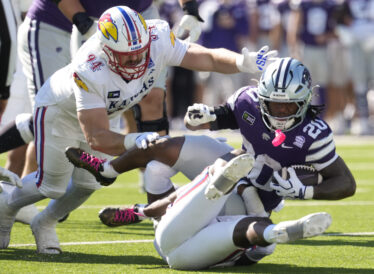
Quarterback Avery Johnson ran for 59 yards on K-State’s first play, running back Joe Jackson carried the ball 21 times for 137 yards and a touchdown in the final 21 minutes and 36 seconds alone, and in all K-State ran for 359 yards on 51 carries for an average of 7.0 per attempt.
KU coach Lance Leipold acknowledged postgame that the Jayhawks got “pushed around” to an uncommon degree; they allowed their highest rushing total since a calendar year earlier at Texas Tech.
“They were more physical than we were today in that regard, it sure appeared,” Leipold said. “I’ve got to dive into it more as we watch and see where it’s at.”
Johnson did a lot of his damage on quarterback scrambles — specifically gaining 57% of his yardage in that fashion. But he also took a designed run for 37 yards on the play that all but sealed the game for K-State.
“As we talked all week, you got to try to contain Avery Johnson the best you can,” Leipold said, “and we didn’t do that very well, especially right away in the first quarter, and you could see their confidence rise with some big plays.”
The most frequent issues for KU, though, were on straightforward inside runs by the Wildcat backs. The Jayhawks did not tackle a running back for a loss all day. Of their three tackles for loss, one was a sack and two more were on Johnson behind the line of scrimmage.
That led to favorable downs and distances for the Wildcats throughout and drives like their five-minute clock-killing endeavor late in the fourth quarter, which consisted of 10 straight runs and a game-sealing field goal.
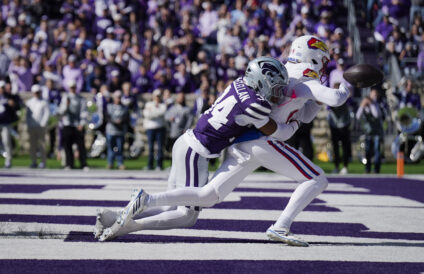
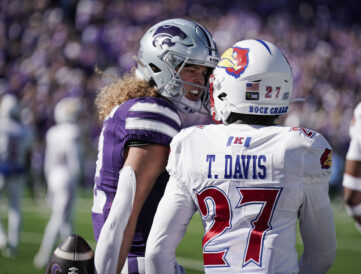
The single most damaging run of the day, though, came earlier in the fourth quarter, when on the next play after quarterback Isaiah Marshall’s backbreaking red-zone interception, Jackson scampered through the right side of the Jayhawks’ defensive line and into open space, racking up 64 yards before Taylor Davis pushed him out of bounds.
It was a familiar sequence that mirrored one late in KU’s loss to Utah, in which the Jayhawks faltered on fourth-and-goal at the 1-yard line and almost immediately allowed a 90-yard rushing touchdown.
Defensive tackle Blake Herold said that over the course of a game, defensive coordinator D.K. McDonald will help keep his unit from getting too high or too low: “If we’re not being physical enough, he’s going to tell us ‘Be more physical,'” Herold said. “If we’re out of our gap, (he’s) going to tell us ‘Just do your job,’ and ‘Eyes on your keys,’ stuff like that.”
McDonald will evidently have plenty more teaching to do as the Jayhawks enter the second half of their season, beginning next Saturday at home against Baylor.
“I just think we got to play more physical, play harder and kind of do our jobs,” Herold said. “Guys popping into the gaps, stuff like that, kind of killed us today. Continue to do our jobs and do what we got to do and continue to be physical throughout the week during practice as well.”
Leipold said of Saturday’s showing, “That’s not what we expect, that’s not what we wanted, that’s not how we play.”
“For a group that’s played pretty well,” he added, “we got to be better upfront.”