As the Kansas football team draws close to the end of its season — though the Jayhawks will be hoping they can grab a couple more upset wins to make it last well into December with a trip to a bowl game — discussions are already underway about who might come back for 2027.
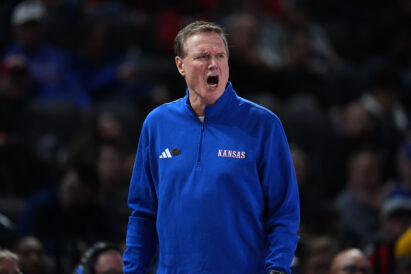
Head coach Lance Leipold said that general manager Rob Ianello and his department are working through some of those talks as the offseason approaches.
“You can’t get to everyone right away, but those things are apparent, and I always view it (as) I’ve got to learn and adapt in that — it’s what part of this is right now, to make sure that we’re starting conversation,” Leipold said. “There’s a lot of talk with agents through times of where it’s at.”
Leipold added that every day can provide a basis for evaluation, not just game days, and that KU is also considering what it needs moving forward that it does not currently have in the program.
But with a relatively small senior class of approximately 15 Jayhawks — the full list of players walking on Saturday’s senior day against No. 12 BYU should be available later in the week — KU has the chance to bring back more of its prominent contributors than in a typical season.
Here are some young players the Jayhawks should emphasize attempting to bring back for 2027 and beyond.
To be clear, this article will center on building-block players who might be at least somewhat under the radar — of course KU should try to bring back quarterback Isaiah Marshall, running backs Dylan Edwards and Yasin Willis, tight end Carson Bruhn and the like and just about any major contributor on defense with remaining eligibility. But the focus here will be young players with promise who could really benefit from more time spent in Lawrence.
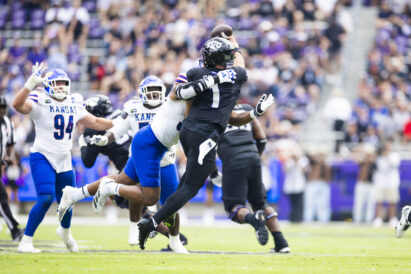
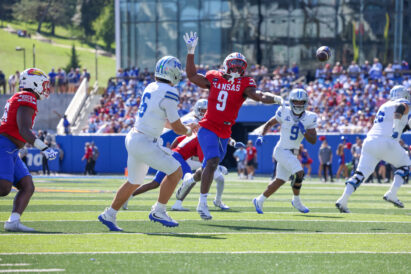
Kansas defensive end Dak Brinkley attempts to get his hand on a pass during the Jayhawks’ game against Middle Tennessee on Saturday, Oct. 3, 2026, at David Booth Memorial Stadium in Lawrence.
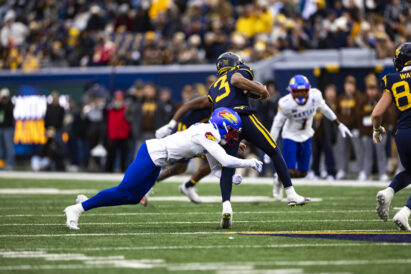
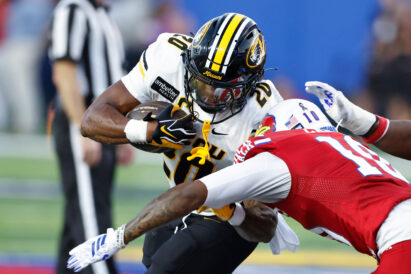
Missouri running back Jamal Roberts (20) attempts to slip past Kansas cornerback Elijah Cannon (10) during the first half of an NCAA college football game in Lawrence.
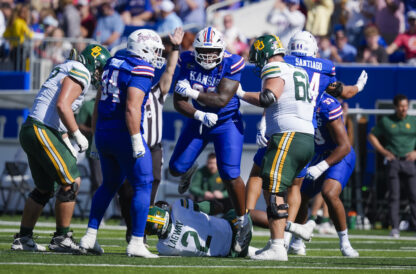
Kansas defensive tackle Kevin Oatis (88) celebrates stopping Baylor quarterback DJ Lagway (2) for a turnover on downs during the second quarter on Saturday, Oct. 24, 2026 at David Booth Kansas Memorial Stadium. Nick Krug/Special to the Journal-World
Dakyus Brinkley, defensive end: The week-in, week-out consistency isn’t always there, but Brinkley’s highs are as high as those of practically any other player on the edge for the Jayhawks, especially when he’s rushing the passer. Pro Football Focus credited Brinkley with six pressures in his career-high 32 defensive snaps of last week’s win over West Virginia. It’s getting easier and easier to see Leroy Harris III making the leap to the NFL as the season progresses, but if the Jayhawks can keep Brinkley and Garrett Martin in the fold to pair with David Santiago next year, they might not suffer much of a drop-off at all in what has been possibly their best overall position group.
Trey Brown and Elijah Cannon, cornerbacks: Both Brown, a true freshman, and Cannon, a redshirt sophomore transfer from Mississippi State, are offseason additions who have far surpassed initial expectations and become consistent contributors for KU at the nickel spot. Under Leipold, true freshmen have rarely contributed to the extent of Brown, who has eight tackles this season and broke up a pass against WVU — but perhaps even more striking is the rise of Cannon, an under-the-radar transfer who took quite quickly to a position lacking options and has started six games after barely playing at Mississippi State. If KU can go through a whole offseason knowing these players are going to figure in, it might get even better in the secondary.
Khijohnn Cummings-Coleman, running back: No one could have foreseen that Cummings-Coleman, with opportunities for playing time minimal at his previous position of safety, would slide over to running back at all, let alone that he would have to contribute meaningfully in Big 12 games due to an outrageous series of injuries at the position. But that’s exactly what has happened, and he’s now carried the ball 33 times for 165 yards and four touchdowns this season. Cummings-Coleman shows an impressive mix of elusiveness and burst and certainly doesn’t often look like a player still growing into the position. Now, it could be a logjam in the backfield next year if most or all of this year’s contributors come back and Kory Amachree and Justin Thurman return from injury. But if KU doesn’t return everybody, why not keep Cummings-Coleman in the mix and give him an actual spring and fall at the position?
Malachi Curvey, linebacker: KU evaluated well at linebacker this past offseason and the Jayhawks have reaped the rewards of increased depth, just as the coaches promised they would. Keeping Curvey in the program would help maintain continuity, especially with fellow weak-side linebackers Jibreel Al-Amin and Bam Crouch set to exhaust their eligibility. There’s a lot to like about a 6-foot-4, 245-pound linebacker who can both come off the edge and play in space.
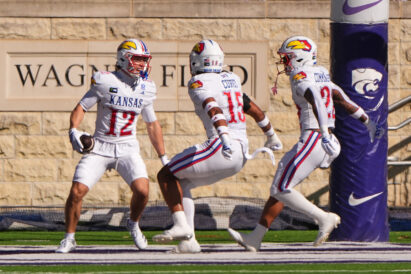
Bryson Hayes, wide receiver: Hayes got hurt this year right around when it seemed like KU was finding interesting ways to deploy his speed, like on a speed option against Kansas State. He also provided a much more obvious example of his skills when he returned a kickoff for a touchdown in that game. The future of the KU receiving corps is a bit unclear; for example, Nik McMillan has what might have been a textbook case for a medical redshirt under old NCAA eligibility rules — he suffered a season-ending injury after two games at Buffalo in 2024 — but the NCAA abolished its waiver process after July 31 and it’s not clear how it might treat anything submitted before then. In any case, KU really hasn’t held on to young wideouts for multiple seasons at a time in recent years and it would do well to stick with Hayes and Tate Nagy.
Anderson Kopp, center: There have been bumps along the way, but all told, KU’s offensive line really hasn’t suffered much since losing Kasen Carpenter in mid-October. Kopp hasn’t missed a beat, even though he’s only a redshirt freshman, and while his pass blocking may need work, his snapping itself has been more consistent than Carpenter’s was. It’s easy to see the KU legacy as the center of the future for the Jayhawks at this juncture.
Kevin Oatis, defensive tackle: In a perfect world, KU might not have needed Oatis to become a full-fledged rotational contributor on the interior in his second season of college football and first as a Jayhawk. But with Tre’Von McAlpine missing the season and Eamon Smalls not consistently healthy, Oatis has become effectively the third tackle behind Blake Herold and Marcus Calvin. He has been involved in several sacks over the last few weeks and according to PFF missed just the first tackle of his career against West Virginia. On top of that, he has one of the more dynamic personalities on the team and would be a valuable addition to a future Jayhawk locker room. (True freshman Nakwaine Carter also deserves a mention here for finding his way onto the field at such an early stage of his career.)

 Kahner Sampson/Special to the Journal-World
 AP Photo/Colin E. Braley