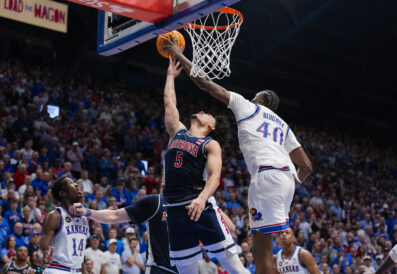
The Kansas team that entered the year ranked No. 19 has proven much more viable as a championship contender than the previous two that were preseason No. 1 selections. Go figure.
That’s not to say the Jayhawks are a shoo-in for the Final Four — who ever is? — or even to make it to the second weekend for the first time in four years, given their uneven results in the month of February. But the combination of exceptional freshman guard Darryn Peterson and a reliable core of veterans around him has earned KU a series of marquee victories over many of the nation’s top teams, inspiring at least some confidence among fans that the Jayhawks can return to glory this March and April.
On the other hand, albeit to a lesser degree than in prior seasons, KU has shown it can lose to lesser opposition. A home loss to Cincinnati in late February served as resounding proof, when it looked like the Jayhawks had moved well beyond their early-January shock losses at UCF and West Virginia, as did the grim result at Arizona State.
It’s not quite the highest level of consistency, but this team has shown it can win six games in a row; in fact, it won eight straight in an impressive streak encompassing nearly half of its league schedule.
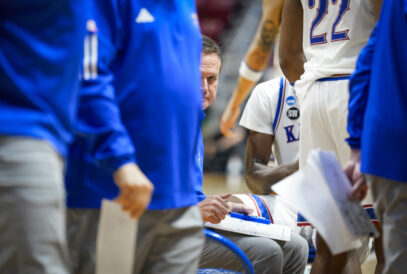
In any case, here’s a more extensive look at the factors working in KU’s favor and the potential concerns as it enters its 23rd NCAA Tournament under head coach Bill Self.
WHY IT COULD WIN
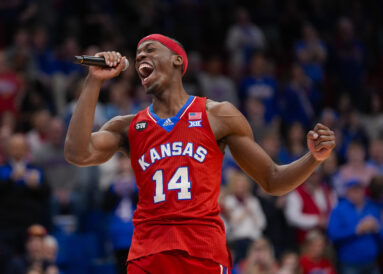
— Best player on the floor: The old NCAA Tournament axiom is that guard play wins in March, and if that wisdom holds true this year, it should help the Jayhawks’ chances (a bit of an understatement) that they have arguably the best guard in the country on their roster. The Jayhawks won several battles in league play in large part on the strength of 20-point first halves from Peterson, even when he wasn’t able to finish games. No one can score like him, and now he’s put together a series of full games. If he can translate that into a couple of 30- or 35-point games in March, which really doesn’t seem like that much of a stretch if he can find a way to balance 3-point shooting with getting to the rim, it can erase any other issues KU may encounter.
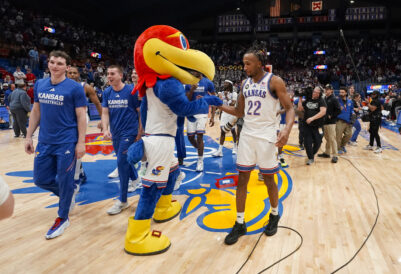
— Group mind: Every team spends the offseason telling reporters how much all its players love each other. But more than ever, at least among recent KU squads, the 2025-26 Jayhawks have displayed a high level of team chemistry. Led by the energy and emotion of Melvin Council Jr. and Tre White, the group of players has meshed exceptionally well despite none of them having played together prior to the year. Self said their rapport is apparent when they eat together and in the meeting rooms and then it comes out on the court. They also clearly have a great sense of accountability, given the impact of the January players-only meeting and the frequent occasions on which Council has pushed a teammate to success by challenging him pre- or midgame.
— Defense travels: It hasn’t always been perfect by any means. But the Jayhawks have in many of their games this year lived up to Self’s ethos by making other teams play poorly, to offset the possibility that they themselves might not be playing well. KU’s first-shot defense has been stifling all season, especially beyond the arc, and Flory Bidunga’s emergence as one of the nation’s premier shot blockers — not to mention his newfound ability to defend every position on the court — has erased so many easy scoring opportunities for opponents throughout the year. The offseason projections that KU had assembled a long, versatile, switchable defensive core proved correct over the course of the year, even if it flagged a bit late in the regular season. Now the Jayhawks’ defensive integrity will get its biggest test yet in March.
— Pressure tested: To put it lightly, last season’s Jayhawks did not have a record of winning close games. After a couple of hard-fought wins in nonconference play over North Carolina and Duke, they lost their nerve late in league losses to Houston and Baylor and couldn’t complete rallies against West Virginia, Utah, Texas Tech and Houston (again). This year’s fresh group has shown much more focus and killer instinct in clutch situations, led by the veteran savvy of Council and White. Consider the comeback against Tennessee in the Players Era, or Council’s explosion at N.C. State in an overtime win, or TCU, or Texas Tech, or Arizona at home. It hasn’t been perfect — the Jayhawks crumbled late in home losses against UConn and especially Cincinnati — but this group is largely unfazed by pressure.
WHY IT COULD NOT
— Nightmare scenario: This must be addressed, because it has been a lingering, deeply unpleasant question ever since Peterson first cramped in an exhibition at Louisville: What if that happens in the tournament? And what if it happens during a game in which, unlike that Louisville exhibition or regular-season battles with Baylor, BYU, Oklahoma State or a handful of others, the outcome is still in doubt? (Certainly Peterson’s exit didn’t help KU’s cause in a tight loss to UCF, although Council caught fire late to such an extent in that one that the Jayhawks almost won anyway.) Self explicitly acknowledged this possibility postgame after KU beat OSU, noting it could lead not just to a loss but to the end of a season. He also said at that time, though, that Peterson’s cramping had recurred when he thought KU was past it. He is very correct that another recurrence at the wrong moment could kill the Jayhawks.
— Two different teams: In part because Peterson has been in and out due to cramping, illness, and hamstring and ankle injuries, and for much of the year was hovering around playing 40% of the team’s possible minutes, KU has gotten used to playing without him. That was helpful when it, say, beat the No. 1 team in the nation without him, but is also a bit problematic given that it is entering the postseason with him. There have been some moments where Peterson’s integration with the likes of Bidunga, Council, Bryson Tiller and White has looked seamless and others in which they have looked out of sync or, Council and White especially, not been sure exactly when to defer to the freshman star. Self has spoken repeatedly throughout the year about needing a consistent period of time with all his players in place to hone his team’s identity and cohesion. He didn’t really get that for as long as he would in any other year, and it might cost KU when it matters most.
— Second chances: Bidunga is a good rebounder. So too, increasingly, is Tiller, and so is White, especially for his size at 6-foot-7. Yet the Jayhawks have of late ranked in the 300s in terms of the number of offensive rebounds allowed to their opponents, a quantity that by the end of the regular season had an average in the double digits. Some of that has to do with the lack of complementary efforts from KU’s guards on the long rebounds that carom out to the perimeter after missed 3s, but there have also been games in which Bidunga, Tiller and White have been outmuscled and outworked on the glass and conceded a great number of second chances. This is in some sense the Achilles heel of KU’s defense. Its first-shot defense is excellent. From then on, all bets are off.
— Hanging by a thread: The best ability for Bidunga has been his availability. As a freshman in 2024-25, he committed a foul every seven minutes and 16 seconds he was in the game. As a sophomore, as of late February, that time period had nearly doubled, attesting to his remarkable growth as a disciplined defender. That has been particularly pivotal because of Tiller’s rapid ascension into an every-day starter — just three games into the year — and one of the best freshmen in the conference, which meant he couldn’t just serve as Bidunga’s backup. The downside of that, however, is that KU doesn’t really have depth in the post. For much of the year, the Jayhawks have just gone to a smaller five with Tre White at power forward. That has been problematic at times against two-big lineups (consider the road game against Arizona). The only other real option is Paul Mbiya, who is incredibly raw at this stage of his career, probably more so than expected when he joined the team, even if he has improved over the course of the season. In short, one illegal screen call on Bidunga — or Tiller for that matter — when he already has an early foul could put KU in a big hole.
2026 NCAA Tournament Preview
A deeper look at No. 13 Cal Baptist
KU’s region includes plenty of intrigue
Reasons KU could win it all — or not
How KU’s highest-ranked one-and-dones have fared in March
Melvin Council Jr.: The making of an all-time fan favorite
Extras
KU women’s basketball accepts WBIT invite
KU’s history as No. 4 seed, in San Diego and Washington
Forgotten moments from the 2025-26 season