

The Kansas men’s basketball team broke the seal by bringing back Tre White last Friday, and then the KU football team had already acquired transfers Chase Belcher and Clifton Thompson by Monday.
These are the first three known athletes to join KU this year after obtaining eligibility in the courts. All three are currently eligible under an injunction from Monroe County, Indiana, one that the NCAA is in the process of appealing.
The question now becomes whether any other KU sports teams will attempt to take advantage of this new market for player acquisition. KU women’s basketball coach Brandon Schneider, for example, recently said he explored both bringing back players from last season as well as acquiring new ones but decided against either course of action.
KU baseball, though, appears to be a prime candidate — and the Jayhawks have plenty of time to figure out how they might choose to proceed, with the luxury of a semester break and a schedule that doesn’t start until February.
KU coach Dan Fitzgerald was asked on Monday about potentially adding players with extended eligibility in a similar fashion to the KU football team.
“We’re in the middle of it right now, of still trying to figure that out and what that looks like for the spring,” Fitzgerald said. “Thankfully, we’ve got some time. These fall sports, they’re up against it. We’ve got time.”
If the Jayhawks wanted to look back to 2026, they would have no shortage of prospective options to consider. Pitchers Kannon Carr and Toby Scheidt and position players Josh Dykhoff and Dariel Osoria all fit the profile of the sort of player that has had some success winning fifth-year eligibility in court in recent weeks and months: They entered college and played four straight seasons before exhausting their eligibility.
Carr, a 6-foot-1 righty, spent two years at Jefferson College and then two at KU as a periodic starter. In 2026, he went 3-2 with a 4.60 ERA in 23 appearances with five starts. Scheidt, a native of Columbia, Missouri, known for his unusual delivery, served as an effective high-leverage reliever for KU in 2026 after three seasons at Bryant, although he was less consistent late in the season.
Dykhoff joined KU from Division II Minnesota Crookston and didn’t take long to adjust to the Big 12. Playing first base, he hit .289 with a .947 OPS to go with 16 home runs and 56 RBIs, starting 58 of the 62 games in which he appeared. He was a second-team all-league selection. Osoria declined somewhat in 2026 as opposed to 2025 for the Jayhawks after beginning his career at Western Oklahoma State College. Originally from The Bronx, New York, he had been second-team all-conference himself as a junior but hit just .233 with nine home runs and 38 RBIs as a senior, although he shone with a four-hit showing in the Lawrence Regional title game.
None of these players is known to have signed a professional contract, but at the same time none of them is known to have joined a fifth-year lawsuit at this point either. And it’s not like other baseball players haven’t done so: The Indiana lawsuit that includes Belcher, Thompson and White has seven baseball players among its 97 plaintiffs. That’s just one such case of many around the country.
The coming months will reveal how avidly KU pursues new talent in this realm.
“Certainly we are always looking for every avenue to always improve our roster, so (it’s) stuff we’re looking at right now,” Fitzgerald said.


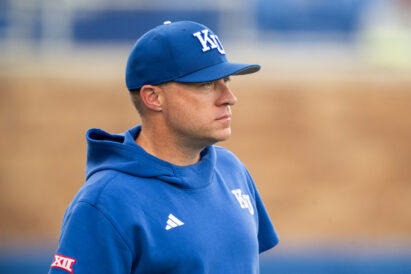 Mike Gunnoe/Special to the Journal-World
