

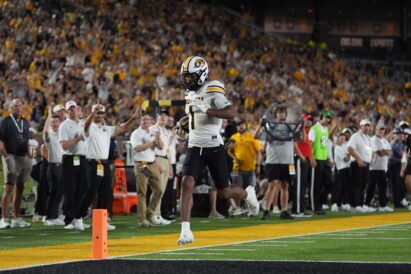
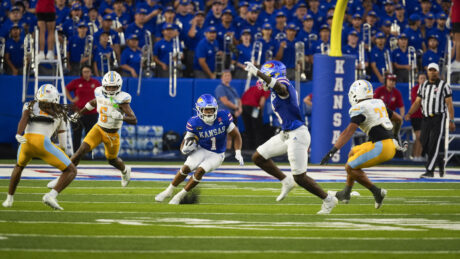
The Kansas defense, which featured plenty of youth along the defensive line and in the secondary last year, now contains some of the most experienced position groups on the entire team.
With that returning quality, a host of transfer additions at defensive tackle, linebacker and safety and another offseason of development in defensive coordinator D.K. McDonald’s scheme, there’s reason to believe KU can take a significant step forward on this side of the ball after its erratic 2025 campaign.
Here are some of the questions about the unit that persist as the Jayhawks go through summer workouts ahead of August’s fall camp.
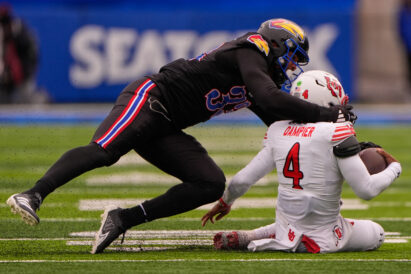
Kansas defensive end Leroy Harris III (33) tackles Utah quarterback Devon Dampier (4) during the second half of an NCAA college football game Friday, Nov. 28, 2025, in Lawrence.
— Can Harris make the leap?
Under head coach Lance Leipold, KU has done well to find diamonds in the rough at the defensive end position. The defining example to this point is Austin Booker, who came to Lawrence as a little-used transfer from Minnesota and left as a Big 12 defensive newcomer of the year, first-team all-conference selection and NFL draft pick; he started nine games as a second-year player for the Chicago Bears last year.
Dean Miller followed Booker with a breakout campaign of his own in 2024, but then faded to the background in 2025, in part because of the emergence of Leroy Harris III, who seems to be next in this lineage. Harris did not receive a lot of attention when he picked KU in the spring of 2025 as a young transfer from Chattanooga, but he ended up earning more snaps than Miller as one of the highest-graded players on Pro Football Focus on the Jayhawks’ defense and led KU in sacks (4.5) and pass breakups (eight). He also blocked a field goal.
If KU is to generate pressure on opposing quarterbacks — something it did not do consistently in 2025 — it will need even more from Harris, who is now listed at 6-foot-5 and 260 pounds. Dakyus Brinkley has a high ceiling himself, Alex Bray should take a step forward on the strong side and Michigan State transfer David Santiago will likely see time at both ends of the defensive line. But Harris, the son of a former NFL guard, will have the most to say about the fate of this group in 2026.
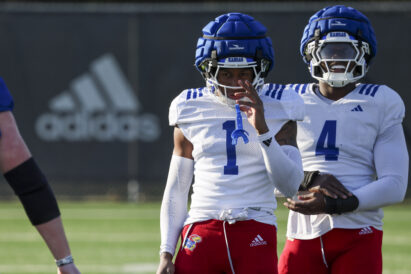
Kansas defensive tackle Tre’von McAlpine participates in Kansas football’s spring practice on Thursday, March 26, 2026, in Lawrence.
— Will injuries impact the defensive tackle room?
Tre’Von McAlpine was one of KU’s biggest offseason acquisitions, both literally and figuratively, as a second-team all-conference defensive tackle from a Tulane team that reached the College Football Playoff — with plenty of Big 12 experience under his belt from his previous three years at Texas Tech. He had 35 tackles with a sack and a fumble recovery last season and seemed poised to slot into a big role on the interior defensive line after KU graduated much of its production at his position in the offseason.
McAlpine may still do that, but his status is unclear after an injury suffered at some point during spring practice that prompted position coach Jim Panagos to say he was “banged up for spring.” Leipold hasn’t spoken to local reporters since then, so there hasn’t been definitive word on the severity of his situation. In any case, despite the lack of a spring portal window, the Jayhawks were able to add a new defensive tackle in Jalen Atkins from Coffeyville Community College.
Redshirt junior Blake Herold will likely be one of KU’s best overall players in 2026 — he was in 2025, too — but any other player at the position will need to make some sort of leap forward. Herold’s classmate Marcus Calvin has only ever been a fringe rotational player, while Eamon Smalls was playing at UAB. KU likes to rotate extensively on the defensive line, though, especially, with McDonald’s multiple fronts, so it would be a surprise if Jibriel Conde or Kevin Oatis didn’t also find ways to get involved.
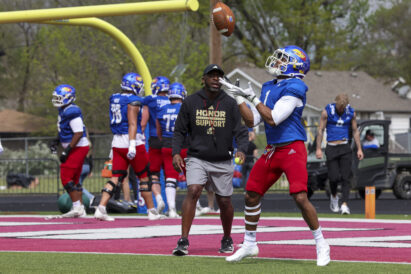
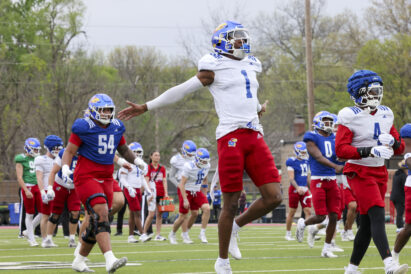
Kansas cornerback Jalen Todd goes through warmups during KU Football’s spring practice at Lawrence High School on Saturday, April 11, 2026 in Lawrence.
— How much does a year of seasoning help the cornerbacks?
There were always going to be growing pains for KU in the secondary in 2025. Not only because the Jayhawks shifted to more consistently using a 4-2-5 look with a fifth defensive back under McDonald than they had in previous years under Brian Borland, but also because they featured a pair of second-year corners — true sophomore Jalen Todd and redshirt freshman Austin Alexander — starting on the outside after years of known quantities Cobee Bryant and Mello Dotson. (D.J. Graham II, a veteran transfer from Utah State, was also in the mix in 2025.)
It did not go all that well. Todd, who had seen some playing time as a third corner the prior year, had a largely solid season. Alexander, though, struggled with missed tackles and when left on an island against some of the top players in the Big 12. When injuries left KU thin at its newly implemented nickel spot, Todd had to slide inside, which meant more time on the outside for Syeed Gibbs. In the final two games of the season, Gibbs allowed nine receptions on 11 targets for 137 yards and two touchdowns, according to PFF.
Perhaps the most glaring stat about KU’s secondary was that no cornerback intercepted a pass all season, which reflects the quiet passivity of the unit, something that hurt KU at times when it gave receivers from teams like Cincinnati significant cushions in key moments. (The Jayhawks also, for better or worse, did not have a defensive pass interference penalty accepted until the fourth quarter of their 10th game.)
With Alexander, Gibbs, Todd and Jahlil Hurley all back and Roman Pearson newly arrived from Ball State, it’s easy to envision a more confident and mature unit taking the field this year.
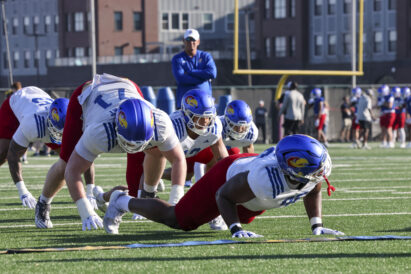
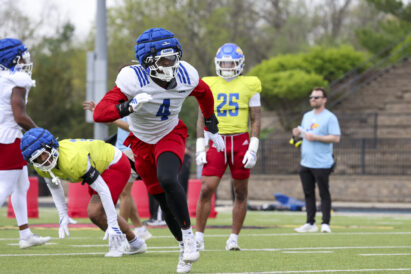
Kansas linebacker Trey Lathan tracks a ball carrier during KU Football’s spring practice at Lawrence High School on Saturday, April 11, 2026 in Lawrence.
— How much does added depth help Lathan?
Trey Lathan emerged as one of KU’s best overall players last season, finishing as the Jayhawks’ leading tackler with 86 stops to go with an interception, a forced fumble and two fumble recoveries. So it made sense that they would want him on the field as much as possible, to the point that he played 713 snaps (per PFF), the highest total on the defense.
But that left Lathan with quite the workload, as he was on the field 87% of the time. He simply had to be, because fellow transfer Joseph Sipp Jr. was a nonfactor after an injury in fall camp (he played 18 snaps and transferred out to Florida Atlantic) and the Jayhawks didn’t really have other players who made sense at the middle linebacker position.
The offseason was a fruitful one for KU at that spot, most notably because it convinced Lathan to stay after he himself had initially entered the portal, but also because of the additions of Bam Crouch (Boston College) and Quincy Davis (New Mexico State), among other transfer linebackers. Both Crouch and Davis — the latter was one of the surprises of the spring — should be able to play in the middle; whether KU ultimately deems their skill sets more suitable for the middle or weak-side spots remains to be seen, but the mere option of giving Lathan some occasional rest without a significant drop-off in quality should be a boon to the Jayhawks next season.
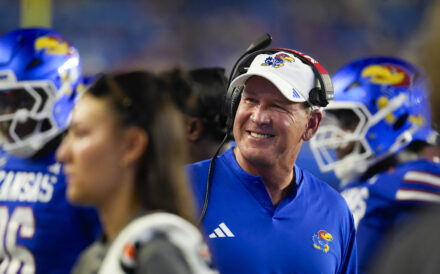
D.K. McDonald coaches during fall camp in Lawrence on Wednesday, July 31, 2024.
— How settled is the scheme?
Last offseason, KU did well to keep its cards close to the vest in terms of how exactly McDonald was going to run his defense. While the transition to more frequently using a fifth defensive back as opposed to a hybrid safety/linebacker wasn’t a shock, it was somewhat more surprising to see McDonald deviate from a four-man front to adopt a more multiple approach that included three- and five-man looks.
It is evident in how KU has recently recruited defensive backs and especially defensive tackles (consider the different frames and experiences of a nose tackle like McAlpine as compared to a former defensive end like Conde) that it will continue in this vein to some extent.
But how KU chooses to line up defensively beginning on Sept. 4 against Long Island will provide a sense of what lessons McDonald learned from his first season as a defensive coordinator. Will he lean even more into the three- and five-man fronts or will the four-man look to which KU initially recruited many of its players experience a resurgence? Is there a place for someone like Marshall transfer Jibreel Al-Amin to play as a third linebacker, or will the Jayhawks remain committed to throwing out a cornerback or safety in their nickel spot? A second full offseason provides an opportunity for McDonald to build out the vision for his defense to a greater extent than he was able to last year.

 Kahner Sampson/Special to the Journal-World
 AP Photo/Charlie Riedel
 Kahner Sampson/Special to the Journal-World
 Kahner Sampson/Special to the Journal-World
 Kahner Sampson/Special to the Journal-World
 Missy Minear/Kansas Athletics