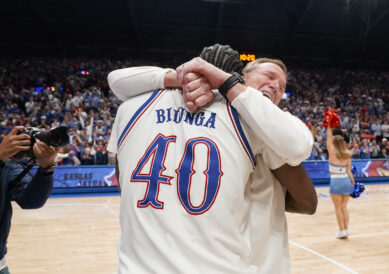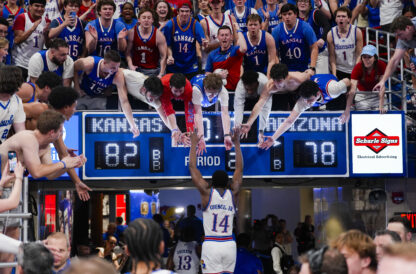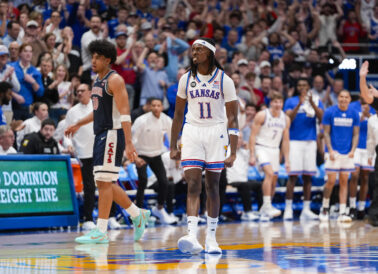
Kansas’ victory over No. 1 Arizona on Monday night will surely be remembered for years and decades to come. It was, after all, KU’s first-ever win over a top-ranked opponent in the 71-year history of Allen Fieldhouse — a new milestone in the so-called cathedral of college basketball.
But what must not be lost, as dog barks and “Seven Nation Army” chants continue to echo after a clangorous night in the Phog, is what the victory over the previously unbeaten Wildcats actually does for the 2025-26 Jayhawks in the near term: KU is now in the thick of the Big 12 race.
That doesn’t feel like it should be such a prominent development for a program that, not so long ago, won at least a share of the conference title for 14 straight years under head coach Bill Self, beginning in 2005 with his second season and concluding in 2018 with his 15th. KU still finished in at least a tie for first three of the following five years.
And then came the 2023-24 and 2024-25 seasons — years in which KU opened as preseason No. 1 and didn’t follow through on its promise, and which, maybe unfairly for the players involved, may well go down as the nadir of the Self era when all is said and done, especially if this year’s widely beloved team continues on its current trajectory and the prospective 2026-27 roster delivers on its own promise. (Of course, it’s a testament to the consistent success Self has had that two seasons with solid winning records and tournament bids will likely be the worst it gets.)
The stories of those two seasons were quite different, to be sure. It’s easy to forget that KU — even with its minimal depth that season — was 12-1 in nonleague play in 2023 and Kevin McCullar Jr. was playing at an All-American level before early road losses to UCF and West Virginia (sound familiar?) jolted the Jayhawks and their fans.
Except that team didn’t respond by rattling off an eight-game winning streak, in part because of what turned into a two-month saga with a bone bruise on McCullar’s knee that had him frequently out of the lineup and far less efficient when he was in it. The Jayhawks were still 9-5 in the league before a series of three losses in the last four regular-season games, including a 30-point blowout at Houston (KU’s last matchup with a No. 1 team prior to Monday), left them sixth of 14 teams entering the Big 12 tournament, and with both McCullar and Hunter Dickinson injured. That year ended with a one-and-done visit to the T-Mobile Center and a second-round exit from March Madness.
The next season, the Jayhawks had plenty more roster depth, but the pieces just never fit together. Lawrence native Zeke Mayo left his mark, but highly touted transfers Rylan Griffen and AJ Storr never produced consistently around the returning core of KJ Adams, Dajuan Harris Jr. and Dickinson.
The early-season success of victories over North Carolina and Duke gave way to road losses at Creighton and rival Missouri. KU looked to have found an identity briefly early in conference play when it locked down three straight foes with tight defense, but the Jayhawks’ season never recovered from a late-January stretch in which they suffered inconceivable collapses at home against Houston and away at Baylor in the span of three games.
By mid-February, the Jayhawks hit rock bottom with road losses to BYU and Utah and at that point were just 8-7 in the league. They came in sixth again. A slight uptick late in the season fueled hopes of a run in March, but a late injury to Adams derailed KU in the first round of the NCAA Tournament against Arkansas.
This season has in many ways reversed the trends of the previous two. In a rebuke of 2023-24, KU has not been derailed by its star’s spotty availability. The Jayhawks have quite clearly learned to play with or without Darryn Peterson. Some of their biggest wins this year — against Tennessee in the Players Era, and of course on Monday against Arizona — came without him, and even in numerous games he has started, they have had to survive key late-game stretches in his absence. For better or worse, the players are now accustomed to two different modes of play.
And in a rebuke of 2024-25, when multiple transfers never seemed to integrate smoothly into the program, the additions to KU’s 2025-26 team have fit seamlessly. Tre White, despite a recent downturn, is still having a career year at his fourth power-conference school and has delivered clutch 3-point shooting on numerous occasions for a team that doesn’t exactly have it in spades. Melvin Council Jr., as Self said on Monday, “has put his handprint on this place as much as anybody possibly could in the short amount of time he’s been here. He owns this place.” Just listen to the barking.
So, with those factors on its side, will KU be able to do what it couldn’t do each of the last two seasons and legitimately contend for a regular-season Big 12 title?
With seven games to go, the Jayhawks aren’t at the top of the league yet — that’s what starting 1-2 will do, even though they’ve won eight in a row since their players-only meeting — but they control their own destiny. At 9-2 in league play, they still narrowly trail Arizona and Houston, which are each 10-1, but have both of those teams left on the schedule — the Wildcats at McKale Center on Feb. 28, the Cougars five days earlier at Allen Fieldhouse. Saturday’s road date with No. 5 Iowa State (8-3), even after the Cyclones’ upset loss at TCU on Tuesday night, will certainly go a long way toward determining the Jayhawks’ long-term viability.
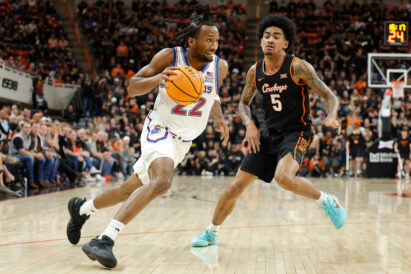
The remaining four games against teams below .500 in the Big 12 — Oklahoma State, Cincinnati, Arizona State and Kansas State — will test KU’s focus and consistency, particularly the road dates with OSU (Feb. 18) and ASU (March 3).
It won’t be easy for the Jayhawks to reach the top of the conference. But of course it never was — they just made it look that way for so long.