


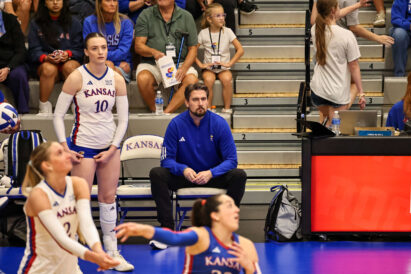
Kansas volleyball coach Matt Ulmer believes a college athlete’s freshman year is always the most difficult. They’re away from home, integrating into a new environment and finding a role on their team.
Ulmer believed that allowing those freshmen to play more here or there would be a beneficial way to keep the younger players invested and engaged. Coaches had to balance that with preserving redshirts to keep athletes eligible for the future.
But that dilemma is in the past, along with a slew of others that were replaced by new challenges with roster construction and playing time, thanks to the NCAA’s recent change to an age-based eligibility rule in which athletes have five years to play five seasons. Now, freshmen can play as much or as little as coaches like in as many or as few games without having to worry about burning a year of playing time.
“I think that will keep us more engaged, that everyone will get playing time here and there,” Ulmer said of the new rule. “I think that’s a real positive without the stresses of having to compete fully while feeling more connected to the team.”
The coaches approve of the change, but the timing comes with difficulty. The NCAA is entering its second year with roster limits for teams, and most sports have spent the spring and summer building out their teams to compete this season. In addition, the five-for-five eligibility rule change followed by an injunction issued by U.S. District Judge Charlotte Sweeney provided athletes from the 2022 high school graduation class a fifth year of eligibility to align with the NCAA’s new rules.
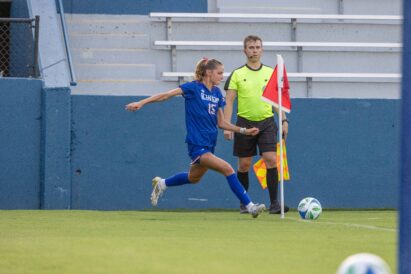
“We’re working through it in real time,” Kansas soccer coach Nate Lie said. “I don’t think it’ll disrupt our team a ton, because I think we do try to build in some flexibility with roster building, but you pair that with roster caps for the first time ever last year, it’s sort of a double whammy and perfect storm.”
It’s a challenge this year for coaches, athletic departments and compliance offices to flesh out who is eligible and who isn’t, and more court cases that alter decisions are always on the horizon, but the new eligibility rules are intended to simplify eligibility for those parties, which is something coaches can certainly get behind.
Rosters are getting older and wiser. The trend started with the spread of the transfer portal and the COVID-19 season in 2020 that didn’t court toward eligibility. Ulmer said the following seasons that featured more five-year contributors saw a “much better product.”
“You have five years as opposed to four, so I think the level goes up,” Ulmer said. “I thought there were a lot of really good teams (in 2021) when you had that fifth year. I think that similar thing will happen here.”
Michael Whittlesey, an assistant coach for KU’s cross-country and track and field teams, said the cross-country team is mostly put together, but that the eligibility change could play a bigger factor during the track season.
KU cross-country redshirted men more than women, as the physical maturation process in male athletes takes longer than with women. Those on the men’s track and field or cross-country teams might still not be consistent runners all five years of eligibility, but more runners on the women’s teams will be able to contribute for five years. That’s where Whittlesey believes the rule change will have the greatest impact.
While more freshmen might get more spot playing time now that coaches don’t have to worry about redshirts, it does make it harder for players to contribute right away because their teammates will have more experience and more physical development. Ulmer said members of the upcoming recruiting classes will have to change their mindset about coming in and starting for a program right away.
“I think it’s a good thing for all youth to understand that it’s going to be hard to play,” Ulmer said. “Sophomore year, it’s going to be hard for you to find playing time. That’s the way it used to be. It’s going to be tough to beat out 22-year-olds when you’re 18, unless you’re pretty phenomenal.”
The softened transfer-portal rules allowing teams to target more upperclassmen at one pole made it harder for incoming freshmen to find roster spots and playing time at the other pole, and the new eligibility rule exacerbates that contradiction. Finding a consistent role on a team of three- to five-year starters is becoming harder and could lead to the younger players feeling more disgruntled.
“It doesn’t matter what age they are or where they are in the world, they’re going to have to be pretty special athletes to come in and have an immediate impact,” Whittlesey said.
Coaches know they can’t please everyone on the team with starting positions and playing time, but that doesn’t mean that the foundation of roster construction has completely flipped from recruiting high school players. Ulmer said it’s more important than ever to succeed there, as five-year team veterans will be the ones that develop a program’s culture.
“You want your culture to be established by the people that are there,” Ulmer said. “If you get a transfer or two along the way, then they come in and fall right in. They know what to do. They’re coming in to something they want to be a part of, not coming in and creating something as a transfer.”
Coaches have spent the last five years working through similar changes in roster construction, and drastic changes to the landscape of college athletes seemingly never stop. The 5-for-5 eligibility format is just the latest wrinkle, and while it’ll change much for this year and beyond, there’s hope that the change can be a positive one that benefits college athletes and the sport.
“Overall, I like it,” Ulmer said. “I think it’s a positive change. I love that our players get two degrees paid for.”
— Sports Editor Henry Greenstein contributed to this story.




 Kahner Sampson/Special to the Journal-World
