

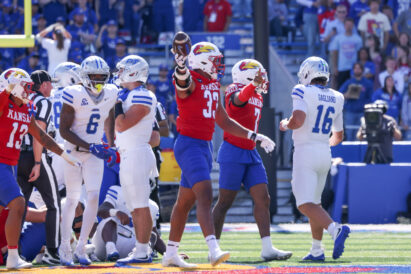
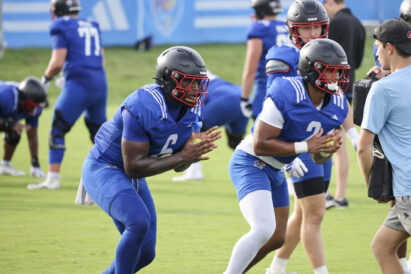
Amid camp battles for positions, a new-look offense and a slew of incoming transfers getting comfortable in a new setting, the Kansas offensive line is jelling together.
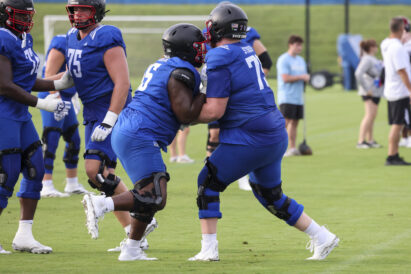
For the Jayhawks on the offensive line, chemistry and communication is as important as technique or understanding of the offensive scheme. The group that plays needs to understand what it sees and what each is thinking to block the defensive front. It’s also a position that rotates less often than most position rooms on the team, which adds to the importance of knowing how to play with the other linemen.
The Jayhawks have made the effort to build that chemistry off the field to perform better on it.
“We’re all really tight,” redshirt junior Connor Stroh said. “We all hang out together, which I think is really awesome.”
Stroh is one of the incoming transfers who is acclimating to the new environment. When he made his move from Texas to Kansas, he made an effort to be himself and to really get to know his new teammates. So far, that plan has worked out, and it’s helped his on-field connection with his fellow Jayhawks.
“Five guys have to act as one in order to succeed,” Stroh said. “The communication between every guy is great, and because we’re so tight, that helps on the field be efficient.”
The importance of thinking the same way can outweigh the importance of thinking the right way. Even if the line has an incorrect call, acting as one during the play is still critical.
Kansas has 19 offensive linemen on the 2026 roster, yet there are only five starting jobs for those Jayhawks to earn. During a game, the Jayhawks might rotate two or three linemen in the lineup, leaving still over 10 Jayhawks not seeing much playing time. But that hasn’t kept the group from getting close and building their relationship together.
“The guys are mature enough to know that we’re competing for each other’s jobs but to also know it is what it is,” Stroh said. “That’s football. (Offensive line) coach (Daryl Agpalsa) makes it clear he’s going to put the best five out there, so there’s no hard feelings.”
Left tackle Calvin Clements is one of the elder statesmen of the offensive line as he enters his fourth year with the Jayhawks. He’s seen his own growth in that time and knows what environment helped him accomplish that. Cultivating a culture that fosters development is something he wants for the incoming linemen on the team.
“It takes a lot of intent with having new guys around,” Clements said. “It’s nothing more than what we’ve always done. We’re always trying to make sure we are on the same page and that the new guys understand the culture.”
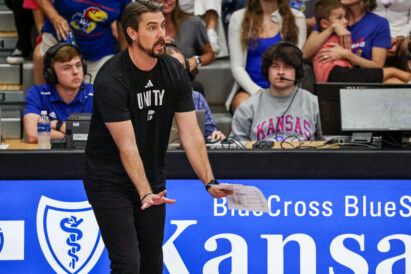
Associate head coach Andy Kotelnicki, who will be the team’s offensive playcaller in 2026, said that the team needs “guys who are athletic and can move and groove and play physical.” Stroh called an offensive line’s physicality “the separator,” and called it “something you have to have to be an o-lineman.”
It’s harder to play fast and physical when linemen are thinking more than they are reacting. That’s where communication along the line with what players are seeing and expecting becomes important — To play to the team’s potential, having a strong connection with each other allows the linemen to think less and play faster and physical.
Nick Morrow is another incoming Jayhawk on the offensive line, and he’s set to take over the right tackle position. It’s a challenging position that requires confidence, as tackles can be left on an island at times during pass protection, but even then, building chemistry remains important for success.
Stroh praised the environment that Kansas had as an incoming transfer. Having gone through recruitment before as high school players, Morrow and Stroh had a good idea of what was real and what wasn’t, and so far, KU has been the real deal. As the season gets going and the Jayhawks face adversity on the field, it is important that the line has a relationship that extends beyond their value on the field.
“There’s a really tight-knit family feel on the team, so getting that connection wasn’t too hard,” Morrow said. “It makes it that much easier when you’re able to connect outside of football and just genuinely care about the guys next to you. It helps a lot.”

 Kahner Sampson/Special to the Journal-World
