

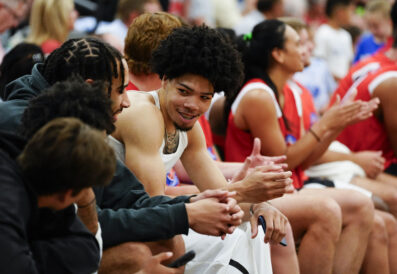
Melvin Council Jr. anticipates submitting another filing in his lawsuit seeking another year of collegiate eligibility, after the NCAA in its recent response broached “a number of issues … that we did not address” in previous arguments, Council’s lawyer Mark Oberstaedt said at a status conference in Douglas County court on Friday afternoon.
Oberstaedt, a Philadelphia-based partner at law firm Archer & Greiner, and Chief Judge Mark Simpson agreed that Council’s side will prepare its latest reply by Aug. 28.
Then, on Sept. 4 at 9 a.m., Simpson will hear arguments by both Council and the NCAA as the recent Kansas guard argues for a temporary injunction that would make him eligible for the 2026-27 basketball season.
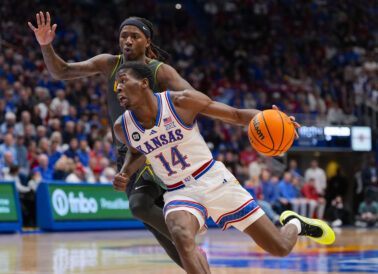
Council, who has already played five years of college basketball — the standard four, plus a one-time waiver for former junior-college athletes — is contending that neither of his years spent at the JUCO level should count toward his NCAA eligibility, so he should have an opportunity to spend a fourth season at a four-year school (and sixth overall). Council filed suit against the NCAA and applied for a temporary injunction on July 23.
The NCAA (and its fellow defendant, NCAA Division I cabinet chair Josh Whitman) responded to the injunction request on Aug. 14, asking for it to be denied and indeed broaching some topics that were not addressed in Council’s initial filings, including perhaps most notably his participation with the New Orleans Pelicans in the NBA Summer League, and an element of Kansas law that purportedly prevents the NCAA from being sued as an individual defendant in the first place.
With two weeks to go before the injunction hearing — which might be a lengthy one, given that NCAA attorney David Zeitlin of Holland & Knight said “the shortest eligibility hearing we’ve had recently has been in the three-to-four-hour range” and many have been some hours longer — Friday’s status conference was brief and largely administrative in nature.
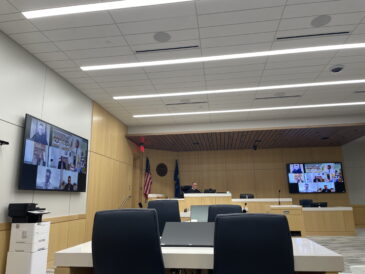
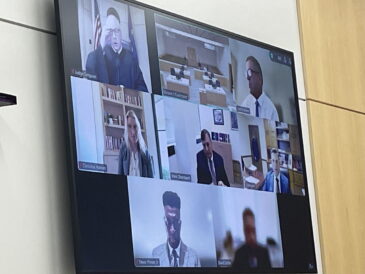
The conference, conducted over a Zoom call with Simpson, included Zeitlin as well as Christina Hansen and Lynn Preheim of Stinson LLP for the NCAA, along with Council’s lawyers Oberstaedt and Trevor Prince Jr. of Archer & Greiner and Matt Rogers of Lawrence’s Barber Emerson.
Zeitlin said the morning of Sept. 4, rather than a full day, could potentially be sufficient for the hearing because Council’s is a case in which the facts are not in dispute so much as the NCAA rules themselves.
Oberstaedt expects to call two to three witnesses, while the NCAA expects one, according to Zeitlin.
Simpson expressed his desire for the hearing to take place in person, and both the plaintiff’s and defendants’ lawyers agreed to attend in person. The NCAA did receive permission for its witness to appear over Zoom, because as Zeitlin said, with various eligibility cases ongoing, “it’s been a significant travel burden that’s impacted our primary witness’ ability to be with his six-month-old.”
Besides serving as the deadline for Council’s reply, Aug. 28 will also be the cutoff for submitted lists of witnesses and exhibits. Simpson agreed to allow until Sept. 1 for lawyers to decide on stipulations ahead of the hearing.
While Council’s side will be supplying additional written arguments ahead of the hearing, neither side said it expected to file a post-hearing memorandum after Sept. 4.
Chief Judge Mark Simpson speaks to lawyers for Melvin Council Jr. and the NCAA via Zoom during a status conference in the Division Five Courtroom on Friday, Aug. 21, 2026. The Zoom call included NCAA lawyers Lynn Preheim and Christina Hansen of Stinson LLP and David Zeitlin of Holland & Knight, as well as Council’s lawyers Mark Oberstaedt and Trevor Prince Jr. of Archer & Greiner and Matt Rogers of Barber Emerson.

 Henry Greenstein/Journal-World