


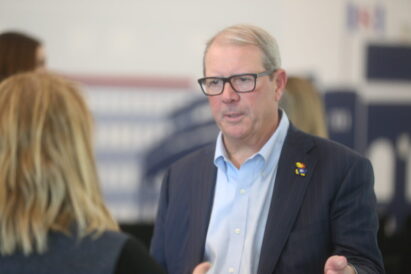
As president of the Big 12 Conference, University of Kansas Chancellor Doug Girod has become accustomed to the continual uncertainty surrounding college athletics.
But there was one longstanding norm that he didn’t think was at any risk of falling: Student-athletes who gamble on their own teams can no longer be eligible to play. But then, on June 8, that norm fell too when a local judge in Texas ruled that incoming Texas Tech quarterback Brendan Sorsby could compete next season despite admitting that he had gambled on the sport and his team.
“It was just a stark demonstration of the challenge that we are in,” Girod told the Journal-World in an interview on Wednesday. “Any local judge can overrule any other entity on our ability to enforce rules.”
Girod said the decision was a shocker.
“Gambling and gambling on your own team in particular has always been a bright line in athletics, professional or otherwise, and to have a local judge just throw that out was pretty distressing to the entire ecosystem,” Girod said.
After the Big 12 filed its own legal motion on the matter, and following widespread condemnation of Texas Tech’s position, Sorsby has since decided to pursue an NFL career, ending his question of college eligibility.
Girod said he was “pleased with where we got when all was said and done,” but he said the episode was a stark reminder of what college athletics desperately needs: Help from Congress.
While the issue of whether a student-athlete who has gambled on his team should remain eligible was a new twist, the overall scenario surrounding the Sorsby incident was not new. The NCAA was taken to court after it tried to enforce one of its rules, and the NCAA ended up the loser. The NCAA recently has been losing more court cases than it has been winning.
“Repeatedly,” Girod said of the NCAA’s track record of losing cases. “And there is really nothing to do about that other than federal legislation.”
Girod and the Big 12 Conference have come out in support of a piece of legislation proposed by Republican Texas Senator Ted Cruz and Democratic Washington Senator Maria Cantwell that would give the NCAA and athletic conferences some antitrust protections that would make it more likely that local judges wouldn’t be overruling the NCAA on enforcement of its rules. It also includes language that prevents state legislatures from passing laws that pre-empt NCAA rules.
Girod, though, said the biggest change that fans might notice from the legislation is that the wholesale transfer of student-athletes at the end of a season would be curtailed.
“I think the biggest noticeable change would most likely be on the transfer portal and creating some stability there,” Girod said. “It would allow you to have some idea of who your team would be next year, which is a bit of a challenge right now.”
Girod said that change is one reason he’s supportive of the proposed legislation. While the increased ability for student-athletes to transfer almost at will has produced some advantages for student-athletes, Girod said even some student-athletes have told him the increased transfers have created some problems too.
“Nor is it easy to argue that it is good for getting an education,” Girod said.
Thus far, the ACC has joined the Big 12 in support of the Protect College Sports Act, but the Big Ten and the SEC have not yet proclaimed support for the legislation. Both conferences — generally regarded as the most powerful in college sports — have expressed concern about a provision in the act that would allow a supermajority of conferences to agree to pool their media rights, which could threaten the lucrative contracts the SEC and Big Ten have with their media partners.
Both conferences also have expressed other concerns about various aspects of the act. Girod, on Wednesday, said the positive aspects of the act outweighed any negatives.
“We don’t think it is perfect, but it is infinitely better than the situation we are in right now,” Girod said.
Girod, however, stopped short of predicting whether the act would win enough votes in Congress.
“This is obviously a bipartisan issue now, and there has been bipartisan acknowledgement that the system is broken,” Girod said. “Where there is not bipartisan agreement is how to fix it.”



 Chad Lawhorn/Journal-World
